
- This topic has 4 replies, 2 voices, and was last updated 7 months ago by
 apossibleworld.
-
AuthorPosts
-
-
February 28, 2026 at 10:47 pm #194809
I’m exploring my H9000 more carefully lately, and learning more about the history of digital reverb units. Which reverb algorithms in H9000 take the most advantage of its processing power? Where are we most likely to hear the difference from plugins, and from the reverbs in the H90?
I have the sense that some reverbs in it are simpler and some more complex, under the hood. For these questions I’m really interested in typical kinds of halls, chambers, rooms etc (setting aside special effects and black hole etc). And are there some algorithms where it gets into the territory of other flagship hardware reverbs (bricasti, lexicon, tc)?
One more reverb question: I notice there are many reverb algorithms in Emote with a graphical interface that’s the same as the SP2016, with the same dropdown list of 6 reverb types. How distinctly different are these algorithms from each other? I don’t mean the 6 types, but all of the different algos that use this UI. It would be interesting to open them in VSIG and analyze the differences, but I haven’t learned how to do that yet.
-
March 2, 2026 at 9:17 am #194821
The newer algorithms from the H9 and H90 are more DSP intensive, but that doesn’t necessarily translate to being our sounding better than some of the older algorithms that require less DSP resources. The best thing I can suggest is experimenting and exploring as much as you can to find the sounds that you are most drawn to.
It is very simple to use VSig to see under the hood of some of these algorithms if you are curious. You just need to go to File > Settings to setup your connection, then click the cloud icon to download an algorithm from your H9000.
The architecture of SP2016 is very different from any of the H8000 reverbs. Can you provide some examples of the reverbs you are seeing with the same UI? There are many algorithms with drop down menus, but SP2016 does not share the same UI as other algorithms. You may be viewing different presets of the SP2016 algorithm.
-
March 5, 2026 at 11:14 am #194854
Thank you for these comments. I’ll try out VSig soon. I’m away from the unit right now so I don’t remember which programs I’m talking about, but it’s all of the ones with the dropdown menu with the 6 SP2016 algorithms (vintage stereo room, modern stereo room etc). There seem to be many that have the same parameters and knob layout and those 6 choices. So I was wondering what makes them different under the hood.
I forget if there’s an SP2016 algorithm that’s native to H9000, as opposed to the one that’s ported from H9 (and includes all the presets). The same way there are two Blackhole algorithms, the one near the top of the list that comes from H9, and the one without the graphic interface that’s just knobs. Those two sound quite different to my ears. The native one (maybe that’s the wrong word) sounds dark and smooth, and the one from H9 is rougher and splashier. It seems brighter, but I haven’t specifically matched settings. But given that there are two different Blackholes, I assume the VSig programming for them is different. Can you shed any light on that?
-
March 5, 2026 at 4:29 pm #194857
You’re welcome.
The image below shows SP2016 Reverb with it’s presets expanded. The number indicates there are 224 presets. These are all variations of the SP2016 algorithm. Is this what you are referring to?
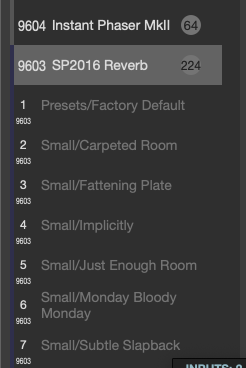
I’m not aware of any other algorithms that have the same dropdown menu and UI. SP2016 was exclusively on the H9000 for a period of time, but it is now available on the H90 as well.
Blackhole 5012 is a legacy algorithm ported from our earlier rackmount units.
Blackhole 9408 was made for the H9 and shares some similar DNA so to speak, but this version is more refined with more specific parameters etc.
The beauty of the H9000 is you have access to everything and can experiment with mixing and matching to taste.
-
March 6, 2026 at 2:00 pm #194870
Thank you, you’re right and I see what happened. When you use the search field, it combines algorithms and presets together in one list, but the Algo box stays lit up, making it seem like the presets are algorithms.
So tell me, for instance, about algorithms 4243 and 4245 – Large Room2 and Really Large Room. They have the exact same parameter layout. How different are they in their actual coding/design, rather than just the default values that they load with?
-
-
AuthorPosts


- You must be logged in to reply to this topic.
